Recipe
Baked feta with thyme honey and cracked pepper
Six-month feta bakes without collapsing. A younger, wetter cheese turns to soup in the same dish.
How-to · 5 min read
Three variables decide whether you get a hard golden crust or a grey slab sitting in its own water — and only one of them is the cheese.
In this note
One centimetre is the floor. Thin slices lose their centre before the surface colours, and what you taste is salt and rubber. At a full centimetre the middle stays soft and milky while the faces take heat.
For skewers or a barbecue, go to a centimetre and a half and accept a slightly longer cook.
Halloumi comes out of brine wet. Water on the surface has to boil off before browning can start, and while it does the cheese is steaming itself.
Pat both faces with a cloth, then leave the slices uncovered on a board for ten minutes. The surface should look matte rather than glossy.
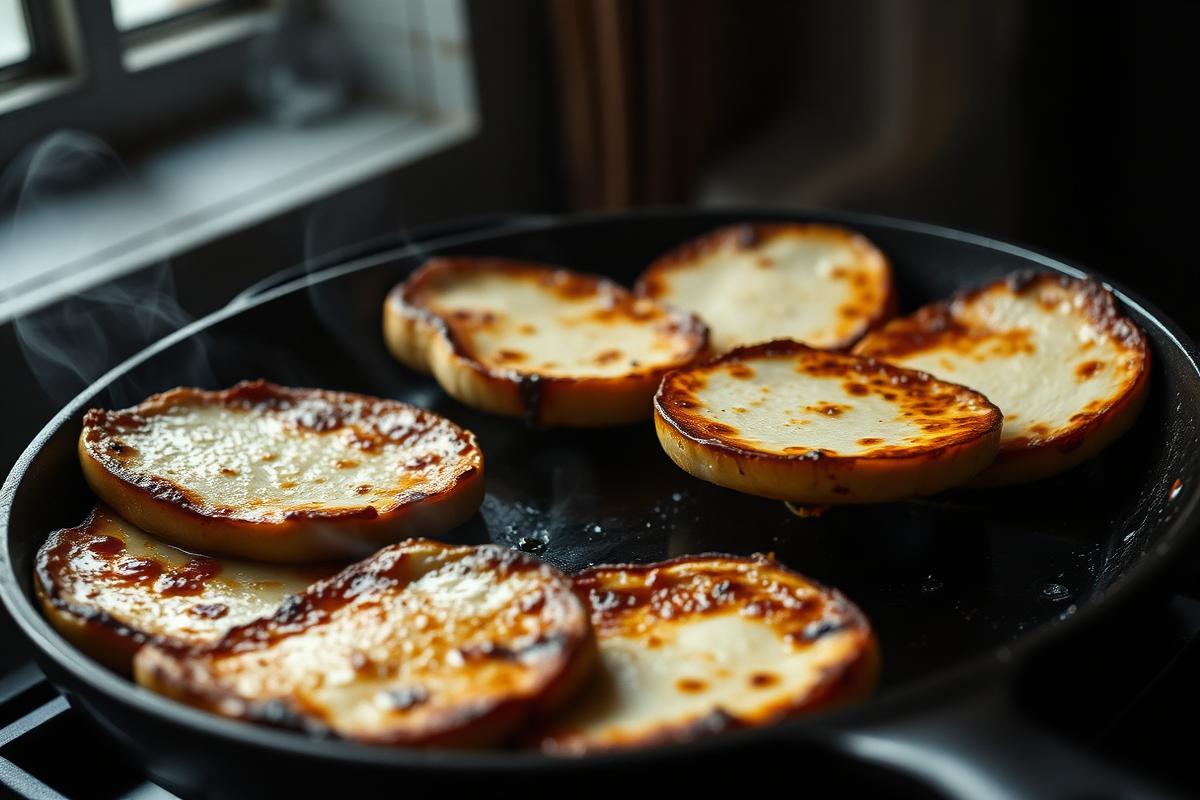
A heavy dry pan over medium-high, no oil. Halloumi carries enough fat of its own, and added oil drops the surface temperature at exactly the wrong moment.
Lay the slices down and do not move them for two to three minutes. Turn once. If they stick, they are not ready; a properly crusted face releases itself.
Halloumi is at its best in the first few minutes off the heat, while the crust is still crisp and the inside soft. Left on a plate it tightens and squeaks again.
Lemon over the top, oregano, a little honey if you want the contrast. Nothing else is needed.
More from the kitchen
Recipe
Six-month feta bakes without collapsing. A younger, wetter cheese turns to soup in the same dish.
Recipe
Hortopita with whatever the hillside gives — and enough salted cheese that you need no other seasoning.
Recipe
The whole argument for buying cheese in a piece rather than a tub of crumbles, in four ingredients.